Driveway guide
How Much Gravel Do I Need for a Driveway?
Tons per 100 feet, base and top layers, real examples and how many truck loads to order, for new driveways and top-ups.
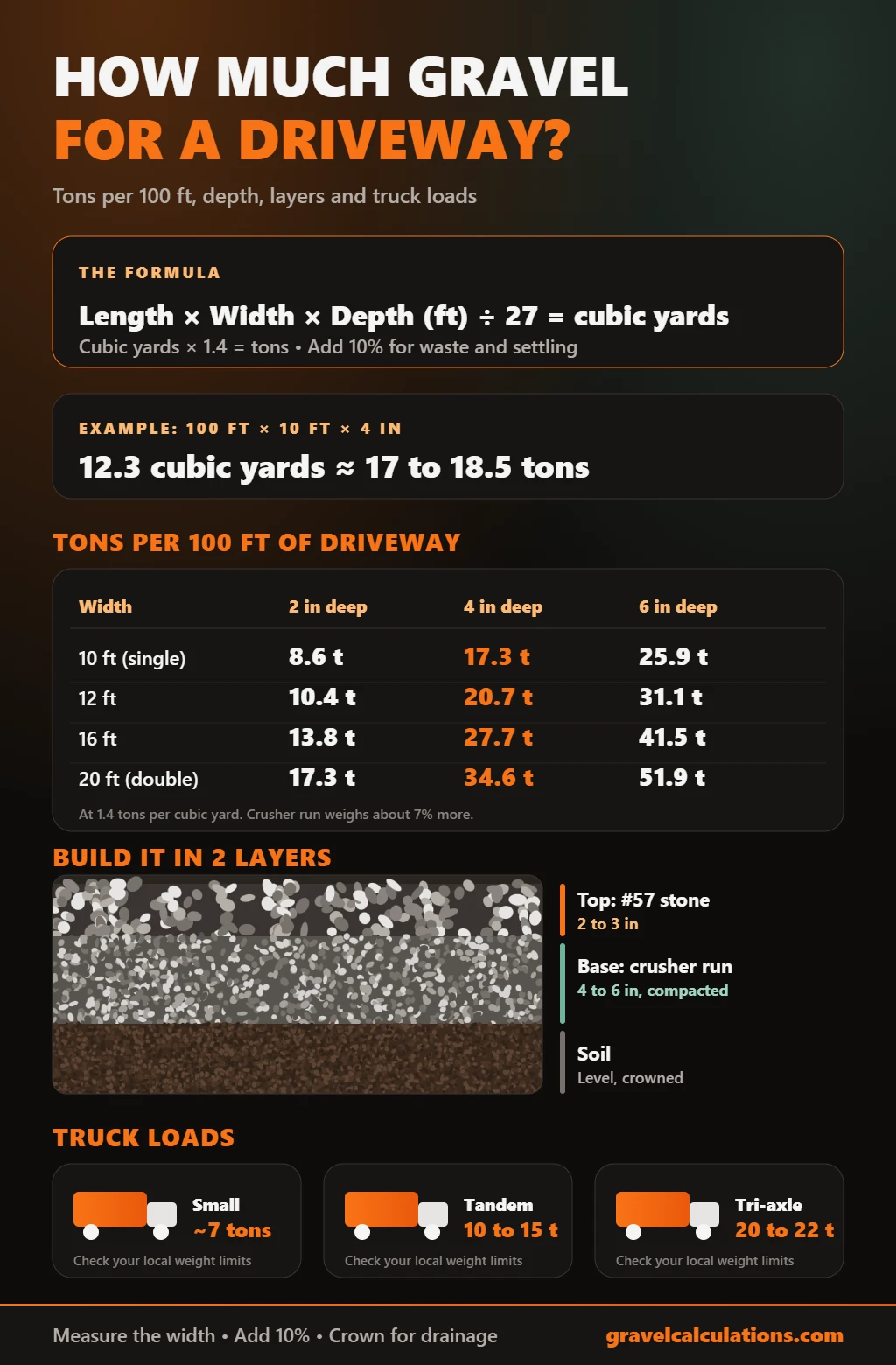
Quick answer: How much gravel for a driveway? Multiply the driveway length x width x depth in feet, divide by 27 to get cubic yards, then multiply by about 1.4 to get tons. A typical 100 ft x 10 ft driveway at 4 inches deep needs about 12.3 cubic yards, or 17 to 18.5 tons of gravel. Add 10% extra for waste and settling.
Working out how much gravel for a driveway is the first step of any gravel driveway project. Driveways use more gravel than any other home project, so a small mistake in width or depth can mean a whole truck load too much or too little. This guide shows how to work out the amount, how much a typical driveway takes, and how to order it without paying for a second delivery.
How to Calculate How Much Gravel for a Driveway
- Measure the length and width in feet. Measure width in a few places and use the average, because driveways are rarely perfectly straight.
- Choose the depth. Convert inches to feet by dividing by 12 (4 inches = 0.333 ft).
- Multiply length x width x depth to get cubic feet.
- Divide by 27 to get cubic yards.
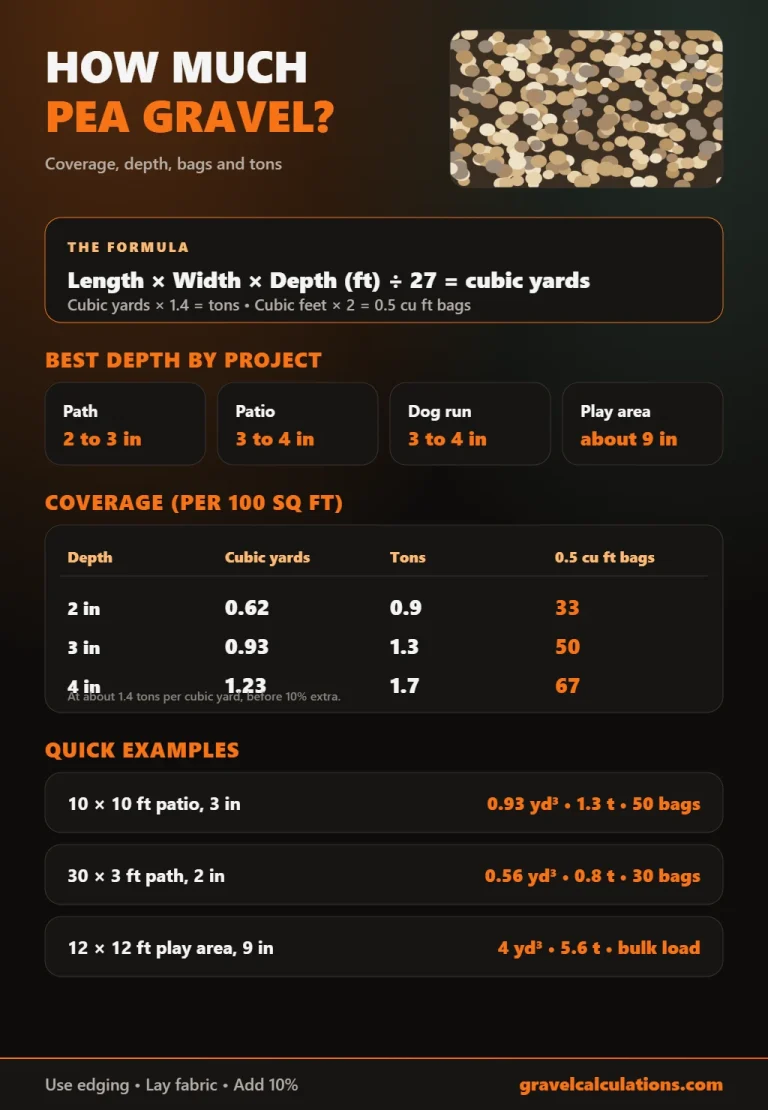
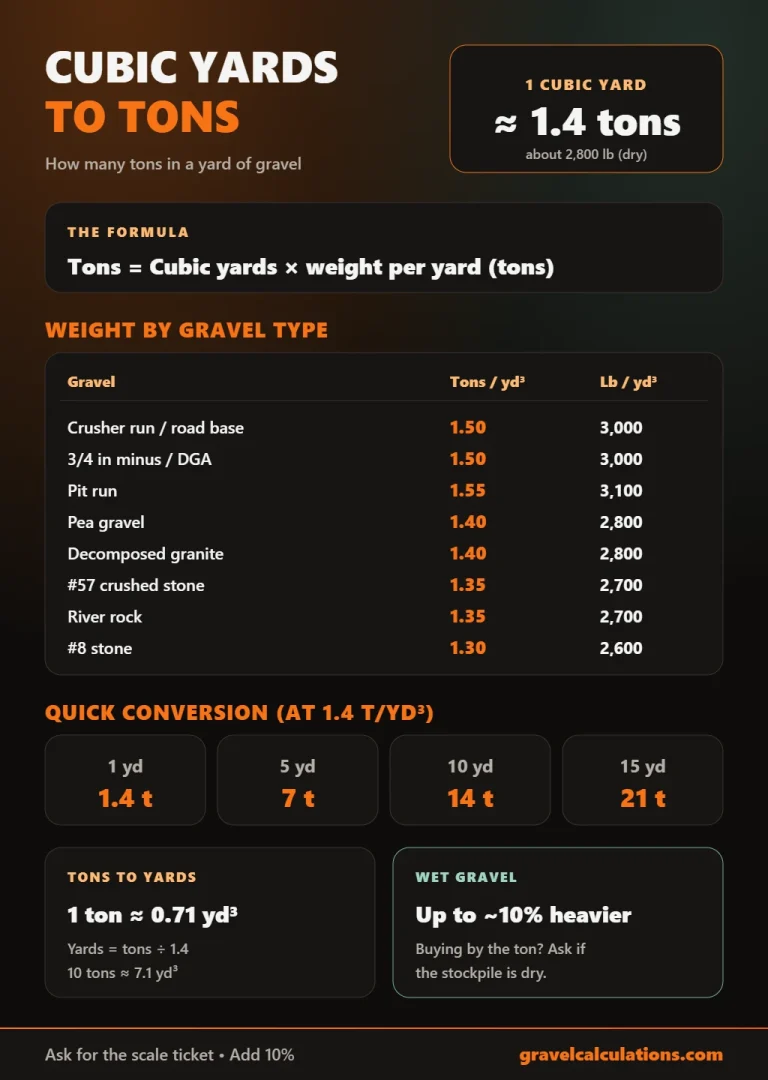
- Multiply by the gravel weight (about 1.4 tons per yard for most gravel, 1.5 for crusher run) to get tons.
- Add 10% for spillage and compaction.
Example: 100 ft long, 10 ft wide, 4 inches deep
100 x 10 x 0.333 = 333 cubic feet
333 ÷ 27 = 12.3 cubic yards
12.3 x 1.4 = 17.3 tons
With 10% extra: about 13.5 yards or 19 tons
Our gravel calculator does all of this for you, including curved and L-shaped driveways, and its Driveway tab works out the base and the top layer separately.
How Much Gravel for a Driveway: Tons per 100 Feet
Most people think in driveway length. This chart shows tons for every 100 feet, at about 1.4 tons per cubic yard and before the 10% extra. Crusher run weighs a little more, so add about 7% if you are ordering it.
| Driveway width | 2 in deep | 4 in deep | 6 in deep |
|---|---|---|---|
| 10 ft (single car) | 8.6 tons | 17.3 tons | 25.9 tons |
| 12 ft (single, roomy) | 10.4 tons | 20.7 tons | 31.1 tons |
| 16 ft | 13.8 tons | 27.7 tons | 41.5 tons |
| 20 ft (double car) | 17.3 tons | 34.6 tons | 51.9 tons |
For a 250 ft driveway, multiply the figure by 2.5. For a 50 ft driveway, halve it.
How Deep Should Driveway Gravel Be?
| Job | Depth | Gravel |
|---|---|---|
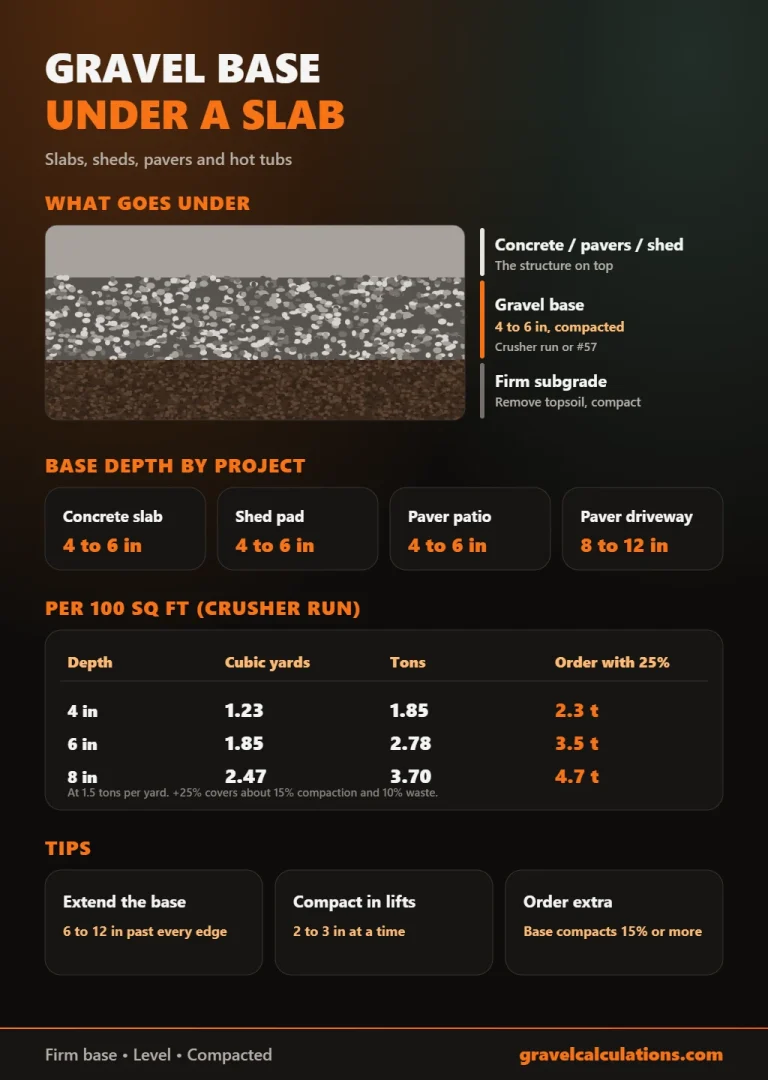
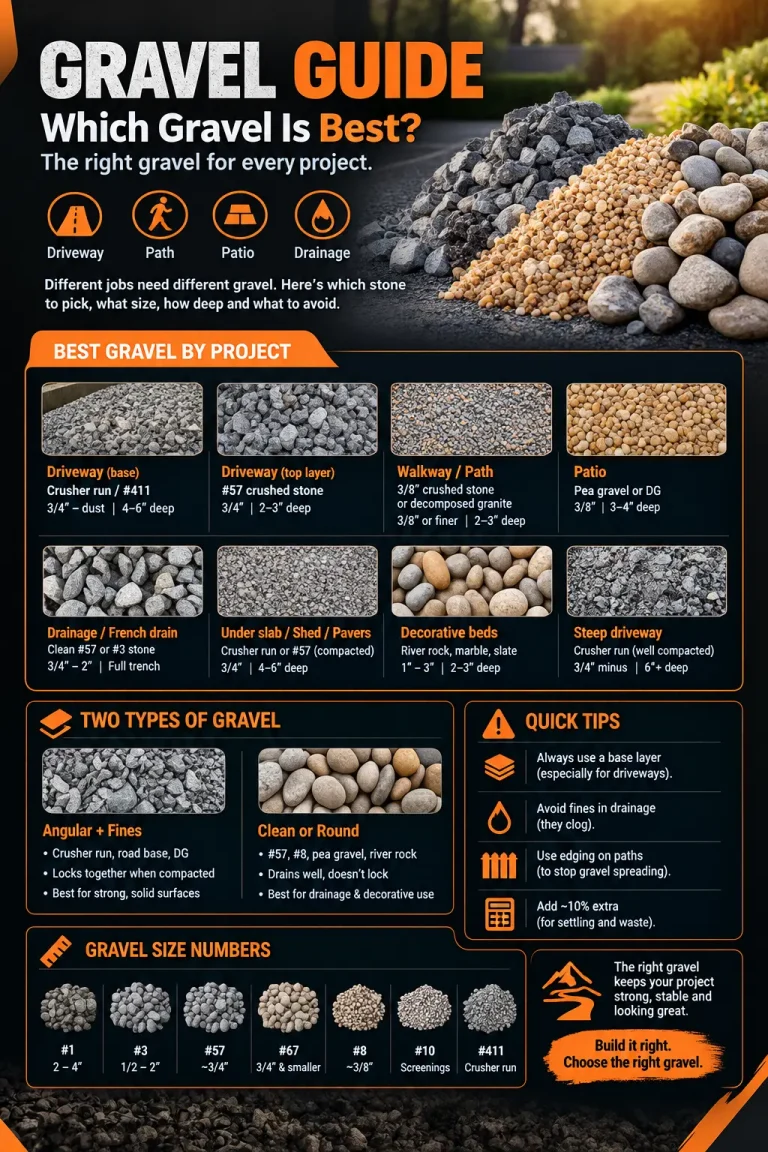
| New driveway, base layer | 4 to 6 in, compacted | Crusher run / road base / #411 |
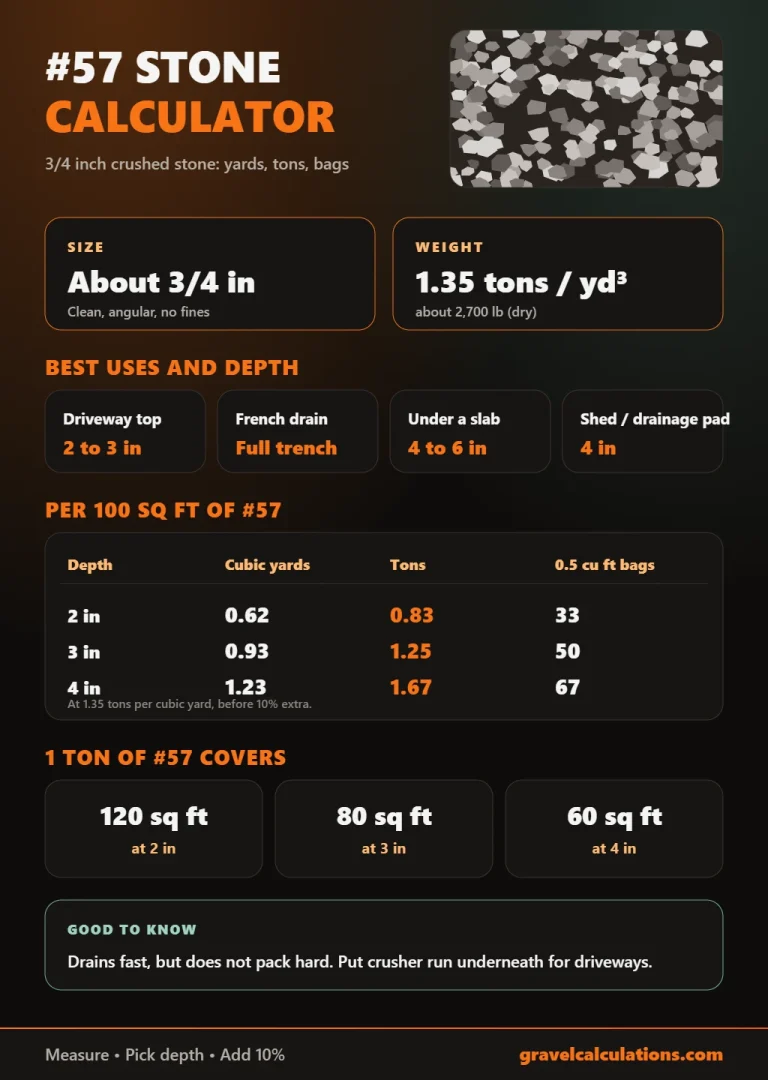
| New driveway, top layer | 2 to 3 in | #57 crushed stone |
| Soft or clay soil, heavy trucks | 8 to 12 in total | Larger base stone (#3 or #1) under crusher run |
| Top-up of an existing driveway | 1 to 2 in | #57 or crusher run to match |
Do not go thicker than about 3 inches with loose top stone. Deeper clean stone never packs down and feels like driving on sand. Choosing the right stone matters as much as knowing how much gravel for a driveway you need. Driveway stone is usually crushed stone rather than natural round gravel. If you are not sure which stone to use, see our guide to which gravel is best for each project.
New Driveway Example: Base and Top Layer
A new driveway 100 ft long and 12 ft wide, built properly in two layers:
| Layer | Depth | Volume | Weight |
|---|---|---|---|
| Base: crusher run | 4 in | 14.8 cu yd | about 22 tons |
| Top: #57 stone | 2 in | 7.4 cu yd | about 10 tons |
| Total with 10% extra | 6 in | 24.4 cu yd | about 35 tons |
That is two separate orders: roughly one tri-axle truck of crusher run and half a load of #57. Spread and compact the base first, ideally wetting it lightly, then add the top stone. This is a good example of how much gravel for a driveway really adds up when you build it properly.
Top-Up Example: Refreshing an Old Driveway
Gravel driveways lose stone every year as it is pushed into the soil and kicked to the edges. Most owners top up every few years. A 150 ft x 10 ft driveway needs about 9.3 cubic yards or 12.5 tons for a 2 inch top-up, or about 13.7 tons with 10% extra. Before you add stone, rake or scarify the old surface to bring buried stone back up and fill potholes first.
How Many Truck Loads?
- Small dump truck: about 5 cubic yards, around 7 tons.
- Tandem dump truck: about 10 to 15 tons.
- Tri-axle truck: about 20 to 22 tons, depending on local road limits.
Delivery usually costs about the same whatever the load, so one full truck is often cheaper per ton than several small ones. Many drivers can also spread the stone as they tip (“tailgating”), which saves you hours of raking. Ask for this when you order.
Common Driveway Gravel Mistakes
- Guessing the width. Width changes the total more than any other number. Measure it.
- Skipping the base. Top stone laid on bare soil sinks and ruts within a season.
- Using round stone. Pea gravel and river rock roll under tyres.
- No crown or drainage. Make the middle slightly higher than the edges so rain runs off. Standing water causes potholes.
- Ordering the exact amount. Running short means a second delivery fee. Add 10%.
- Not checking access. Dump trucks need width, overhead clearance and firm ground.
Work Out Your Driveway
Now you know how much gravel for a driveway of your size to expect. Enter your driveway length and width, pick a width preset or your own size, and choose New driveway or Top-up. The calculator gives you cubic yards, tons, tons per 100 ft and truck loads for each layer.
FAQ
Frequently Asked Questions
How many tons of gravel do I need for a 100 ft driveway?
For a 10 ft wide driveway at 4 inches deep, about 17 to 18.5 tons. For a 12 ft wide driveway at 4 inches, about 21 to 22 tons. Add about 10% for waste and settling.
How deep should gravel be for a driveway?
A new driveway needs about 4 to 6 inches of compacted base (crusher run) plus 2 to 3 inches of top stone such as #57. A top-up on an existing driveway usually needs only 1 to 2 inches.
How many cubic yards of gravel do I need for a driveway?
Multiply length x width x depth in feet and divide by 27. A 100 ft x 10 ft driveway at 4 inches deep is 333 cubic feet, or about 12.3 cubic yards.
How much gravel comes in a dump truck?
A small dump truck carries about 5 cubic yards (around 7 tons). A tandem truck carries about 10 to 15 tons, and a tri-axle carries about 20 to 22 tons, depending on local weight limits.
What is the best gravel for a driveway?
Crusher run (crush and run, road base) for the compacted base, and #57 crushed stone for the top layer. Avoid pea gravel and river rock, because round stones roll under tyres.
Get Your Exact Amount
Driveway gravel in cubic yards, tons and truck loads, base and top layer.